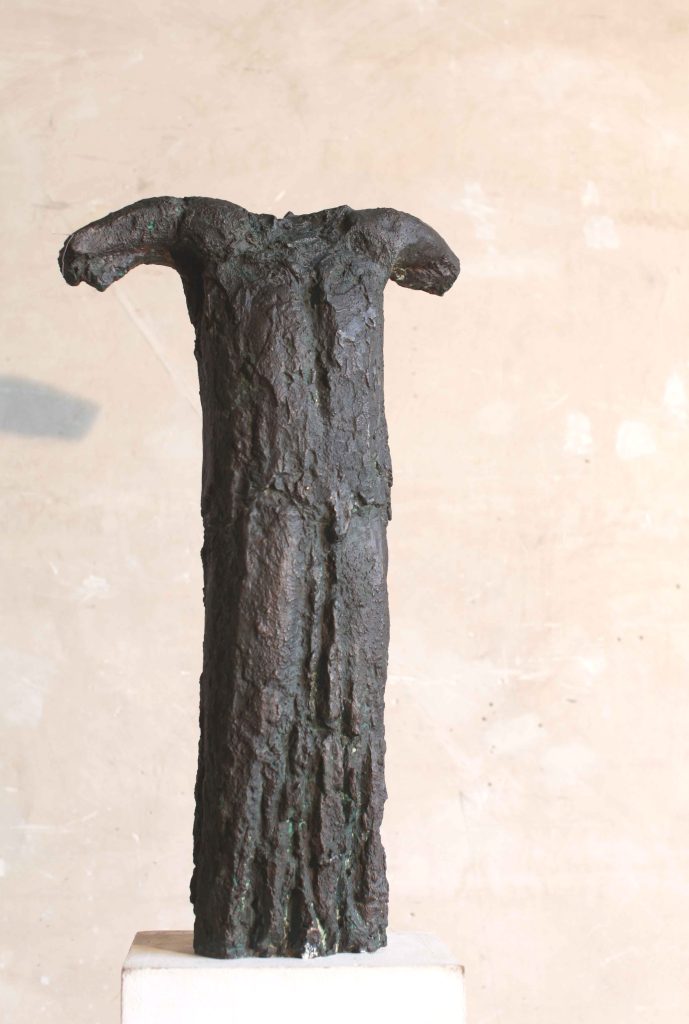
The draped torso reveals agonizingly overextended shoulders, while the body hidden beneath the long shirt appears as a rugged cast surface that ends at the neck in an open cast wound. The headless torso stands at the end of the permanent exhibition in the shadow of the Saxon Exodus and evokes associations of finality. Hope arises through the reference to the Risen One, to the Body of Christ, to the Communion of saints.
The versatile artist Peter Jacobi, born in 1935 in Ploieşti, was assigned to Craiova as an art teacher after graduating from the Academy of Fine Arts in Bucharest. In nearby Târgu Jiu, the artist became acquainted with the sculpture ensemble of the famous Constantin Brâncuşi. The folk art of Oltenia inspired some of his early works. When the bronze cast was donated to the Church Museum in 2013, Peter Jacobi—who has lived in Germany since 1970—wrote the following about the history of the Torso:
“The sculpture was created during the communist era in Romania. I drew inspiration from simple carved biblical scenes on peasant crosses. (…) I began the series of studies for a Crucifixion sculpture back in the 1960s in Romania, partly as a form of opposition to the communist art ideology. After that, I worked on this group of works repeatedly until the bronze casting was finally completed in 2010.”