
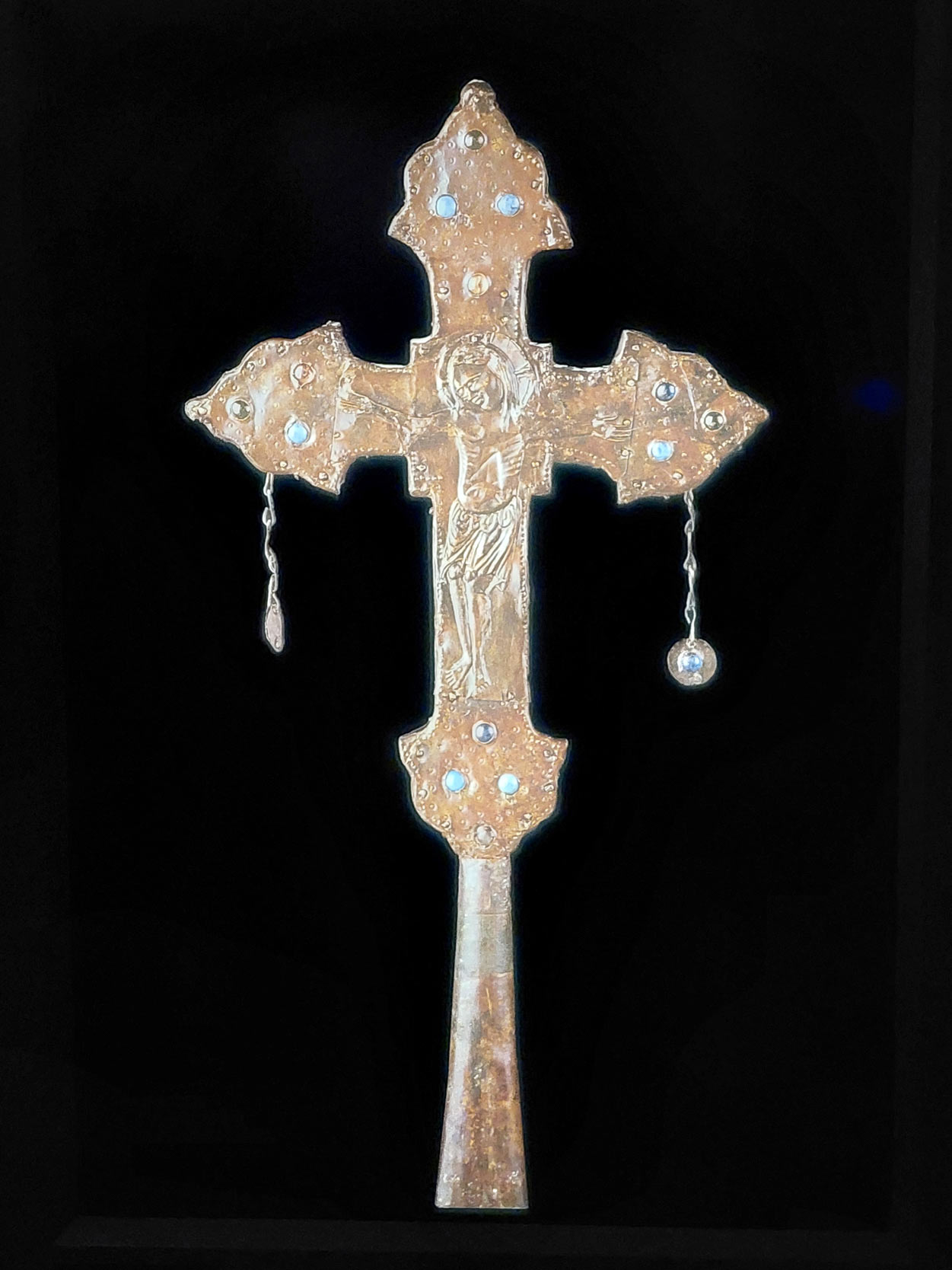
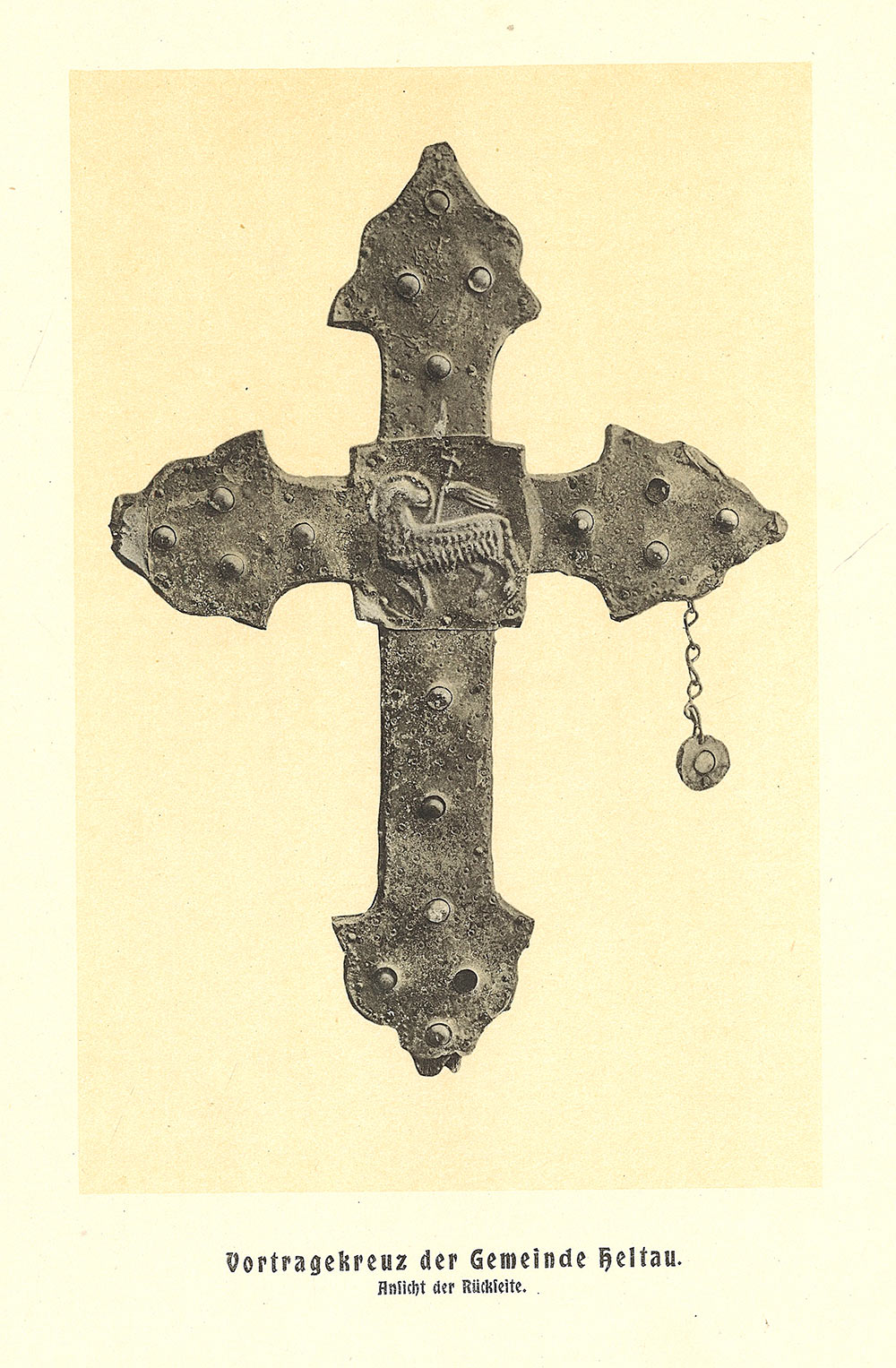
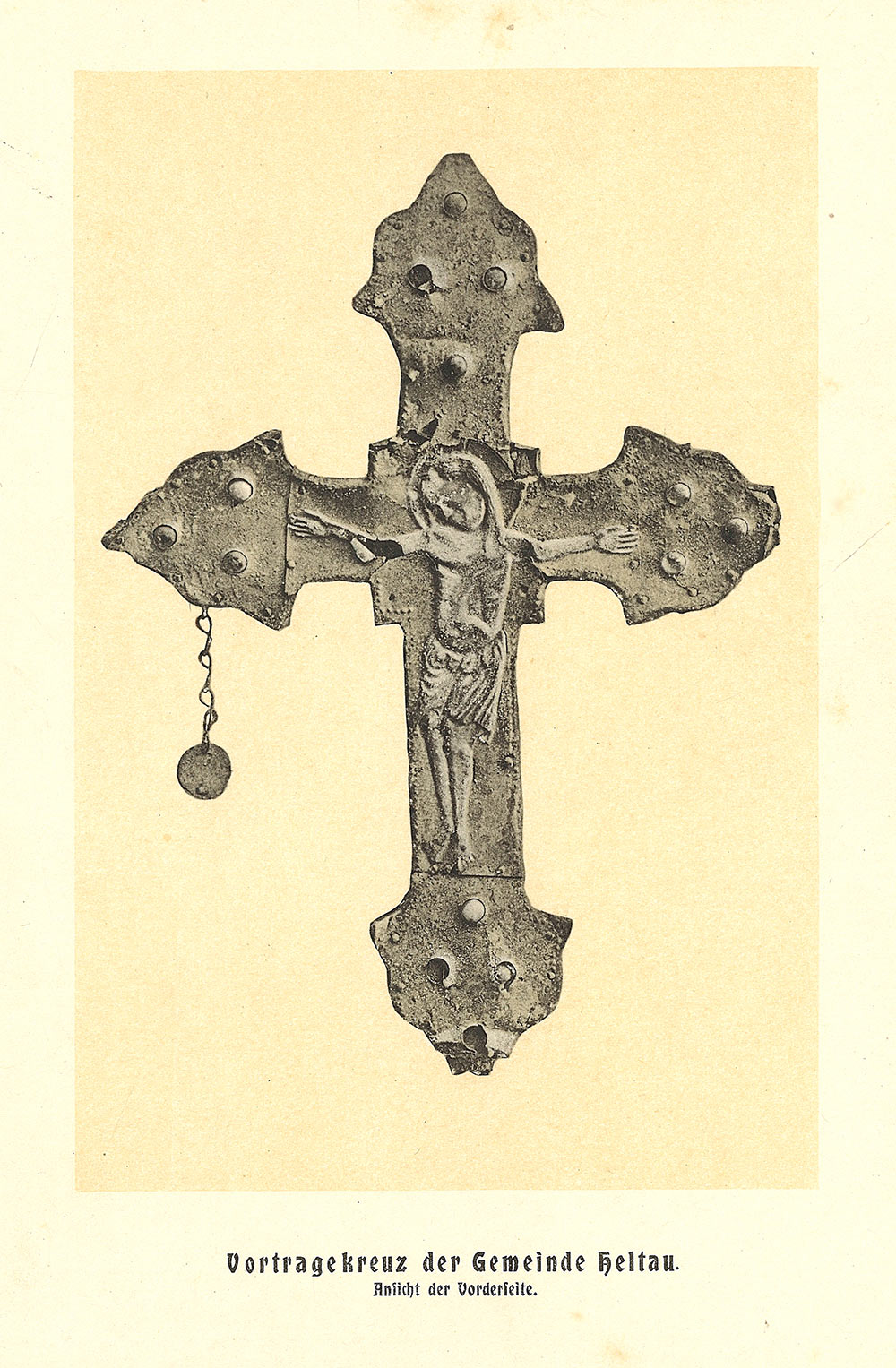
The processional cross was found in 1912 during the renovation of the fortified church in Heltau, in the ossuary of the rotunda.
The Heltau processional cross follows the style of 13th-century models common in the Venetian region. The front shows the dead Christ on the cross – modeled in embossed copper sheet enclosing a wooden core. In the 12th century, Christ was still depicted standing upright on the suppedaneum, wearing majestic features and a crown and spreading his arms in a gesture of blessing. In the 13th century, under the influence of the iconoclasm of the Eastern Church, which had been overcome in the 7th and 8th centuries, the depiction of the suffering Christ prevailed. The iconographic models come from Byzantium, where the iconodules justified the image of the Savior precisely because of his human nature and mortality.
The crucifix is matched on the back of the crossing by a stylized representation of the Lamb of God with the labarum – a reference to the 6th-century Crux Vaticana. The plates at the ends of the cross are each set with three or four round semi-precious stones. Two pendants, each set with a semi-precious stone, hang from the crossbars – referring to Alpha and Omega in accordance with the early medieval Crux Gemmata. Except for the figurative representations, the surface of the cross is covered with a texture of tiny pearl dots as nodes of a Rhombus hatching pattern.
A processional cross from South Tyrol bears a similar Byzantine-style crucifix, the same shape of plates at the ends of the cross, the same surface texture with pearl punching and Rhombus hatching, and the same circular glass stones. However, the ends of the cross bear symbols of the Tetramorph, and the back of the crossbar shows a representation of the Virgin as Maria orans.
In the Friuli-Venezia Giulia region, crosses of this design are more common and were apparently produced in large quantities. Byzantine influences originating in Venice were also very present in other important art centers in the 13th century, such as Pisa and along the Meuse River in present-day Belgium.
The processional cross points to the very heart of our church and encourages us to continue on our path under its sign.
HK
Bibliography
Victor Roth: Kunstdenkmäler aus den sächsischen Kirchen Siebenbürgens I. Goldschmiedearbeiten, Teil 1, Ed. Drotleff Hermannstadt/Sibiu 1922, p.1, cat.1; T 1, 2.
Reinhard Rampold: Mittelalterliche Vortragekreuze in Tirol, Innsbruck 2004
Manlio Leo Mezzacasa: Circulation in Venetian Medieval goldsmith’s art: three case studies between Venice and the Adriatic. In: Convivium. Exchanges and Interactions in the Arts of Medieval Europe, Byzantium, and the Mediterranean, 2014/I, Issue 1, 176-189.